


📰 Introduction:
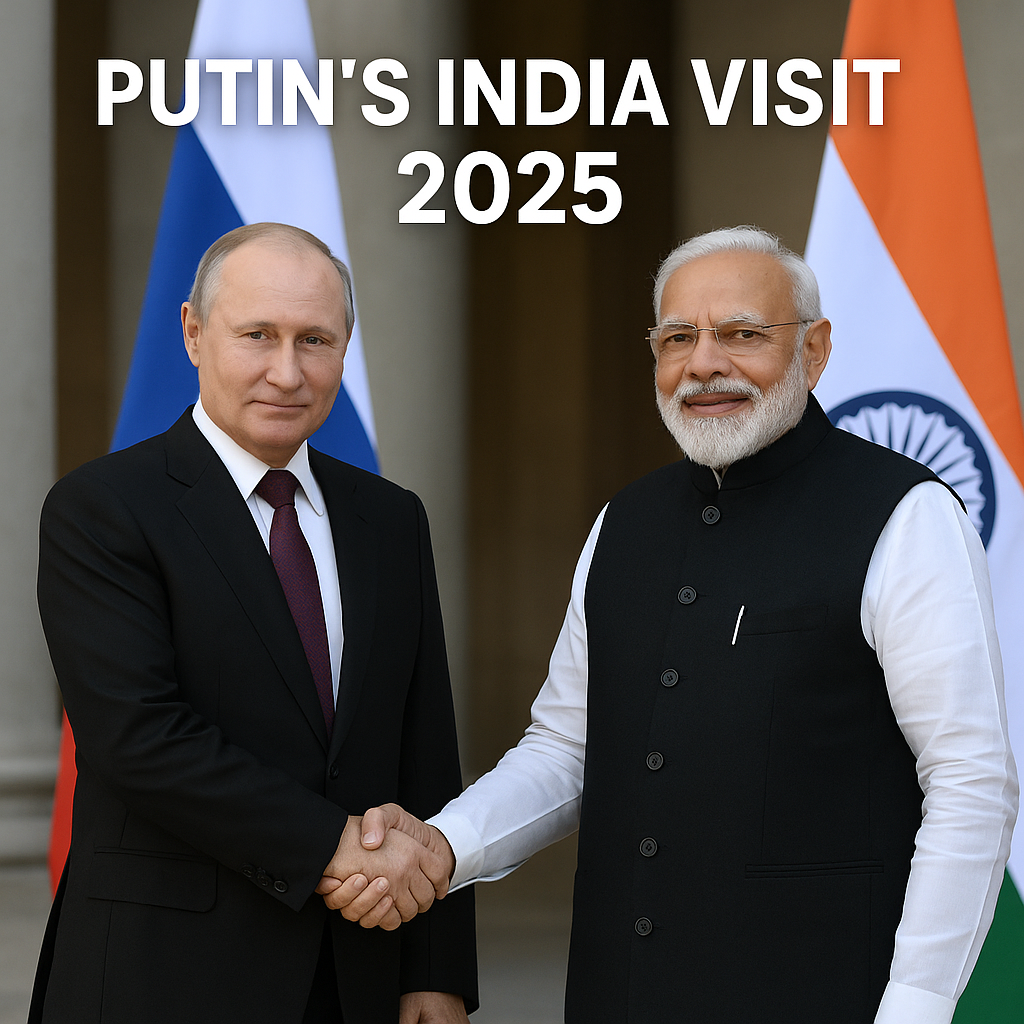
In early December 2025, Vladimir Putin — President of Russian Federation — is scheduled to visit India for a two-day state visit from 4–5 December 2025.
This will mark his first visit to India since the outbreak of the Ukraine war, making it a moment of significant diplomatic importance.
The visit comes at a time when global geopolitics, energy security, defence cooperation and international pressure (especially from the West) are reshaping alliances — so this visit could redefine the next phase of India-Russia relations.
🎯 Key Goals & Agenda of the Visit
During his visit, leaders from both sides — including Narendra Modi (Prime Minister of India) — are expected to address several core areas:
• Strengthening Strategic Partnership
- The 4–5 December 2025 visit is part of the 23rd India–Russia Annual Summit.
- The summit will be used to “review progress on bilateral relations” and to map out a roadmap for the future — across defence, energy, trade, and global diplomacy.
• Defence & Security Cooperation
- Defence ties are high on the agenda, considering many of India’s military platforms are of Russian origin.
- Issues likely to feature: long-pending deliveries of defence hardware (like the S-400 air defence system), upgrades to existing aircraft (e.g. jets already in use), and potential collaboration on future defence manufacturing.
• Energy & Trade: Balancing Imports & Diversifying Exports
- Energy cooperation remains a bedrock of the relationship — with Russian oil and energy supplies being a key factor.
- However, India faces a trade imbalance with Russia: its imports from Russia (mainly energy) far exceed its exports.
- During the summit, there are likely talks about expanding bilateral trade beyond oil — possibly enhancing Indian exports (machinery, pharmaceuticals, etc.) to Russia to even out the trade.
• Geopolitical & Global Diplomacy Angle
- Given ongoing tensions due to the Russia–Ukraine conflict and pressure from Western nations (especially regarding sanctions and oil trade), this visit will also involve navigating global diplomatic pressure.
- Both countries may use this summit to reaffirm their shared strategic vision — potentially signalling a “non-aligned pivot,” with independent foreign policy priorities.
⚠️ Challenges & Key Considerations
This high-stakes visit is not without risks or tough questions. Some of the major challenges likely to shape outcomes:
- Trade imbalance: Historically, India imports much more from Russia than it exports, leading to persistent trade deficit concerns.
- Dependence on Russian defence supply: While defence cooperation is strong, India’s overreliance on Russian equipment raises questions about diversification and long-term self-reliance strategies.
- International pressure, especially from Western powers: Given the Ukraine war and associated sanctions on Russia, India’s tie-ups may come under global scrutiny.
- Need for balanced diplomacy: India must manage its international relationships carefully — balancing a strong partnership with Russia while engaging with other global powers.
🔎 Why This Visit Matters — For India & Russia Both
- Reinforces the long-standing “Special and Privileged Strategic Partnership” between India and Russia — reaffirming mutual trust and long-term cooperation.
- Opens avenues to rebalance trade by increasing Indian exports to Russia — potentially reducing trade deficit and boosting India’s global trade footprint.
- Defence cooperation can get a fresh boost — with possibilities for upgrades and future joint manufacturing, strengthening India’s defence capabilities.
- At global stage, the visit signals that India is charting an independent diplomatic path — not easily swayed by western pressure, but engaging strategically. This could shift geopolitical alignments in subtle ways.
🧑💼 What Should India Do to Maximize Gains from This Visit
- Diversify trade beyond energy — aggressively push Indian exports (machinery, pharma, tech) to Russia to balance trade.
- Use the summit to negotiate favourable payment/settlement mechanisms (given sanctions) — maybe in rupee/rouble or barter deals — to safeguard mutual trade continuity.
- While renewing defence deals, also focus on technology transfer and possible co-manufacturing — reducing sole dependence on imports.
- Continue independent foreign-policy posture, but ensure transparency and communication with other global partners to avoid strategic isolation.
India–Russia Relations: A Partnership Built Over Decades
The India–Russia relationship has always been viewed as one of the most stable and time-tested bilateral partnerships in global geopolitics. Unlike many diplomatic ties that shift rapidly according to global events, the foundation of India–Russia relations has remained consistent for decades. Russia has been a reliable partner for India in defence, space, energy, and strategic technologies. Putin’s 2025 visit, therefore, is not just a diplomatic formality—rather, it represents a continuation of historic trust that the two nations have nurtured for generations.
While global alliances have witnessed significant changes in the last decade, India and Russia have managed to sustain a balanced and respectful relationship. Even when India deepened its engagement with Western nations, Russia’s position remained important for India because of the defence sector, nuclear cooperation, and historical goodwill.
In this context, Putin’s India visit is expected to reinforce continuity as well as open a new chapter in future cooperation.
Defence Collaboration: The Core Pillar of Engagement
India’s defence cooperation with Russia spans nearly 60 years, and many key strategic platforms of the Indian Armed Forces are Russian-origin. From fighter jets to submarines, tanks to missile systems, Russia’s contribution has shaped India’s defence landscape.
During the 2025 visit, both leaders are expected to discuss:
- Upgradation of existing Russian-origin aircraft
- Improved spare-part supply chains
- Faster delivery of pending units
- New-generation military technology collaboration
- More joint manufacturing under “Make in India”
India’s long-term goal is to improve self-reliance in defence production, and Russia remains one of the few countries willing to share strategic technology. The visit could therefore bring fresh agreements on co-development rather than pure imports. This shift helps India reduce dependency while still maintaining its strong strategic ties.
Energy Partnership: Securing India’s Future Needs
Energy is another area where India’s partnership with Russia has grown drastically. Over the last few years, India imported oil from Russia at competitive rates, strengthening its energy security. For India, which is one of the largest energy-consuming nations in the world, diversification is crucial.
Putin’s visit may accelerate:
- Long-term crude oil supply agreements
- Expansion of LNG and natural gas cooperation
- New joint ventures in oil exploration
- Indian investments in Russian energy fields
- Collaboration in nuclear energy projects
These developments are essential for India’s economic stability, especially at a time when the global energy market is constantly fluctuating.
Trade, Commerce, and Economic Balance
One of the most significant challenges in India–Russia economic relations is the trade imbalance. India imports far more from Russia—mainly oil, defence equipment, fertilizers, and critical minerals—than it exports. Putin’s visit aims to address this imbalance through expanded cooperation in sectors such as:
- Pharmaceuticals
- IT and software
- Machinery and manufacturing equipment
- Agricultural products
- Textiles and chemicals
A mutual settlement mechanism could further boost trade, especially with ongoing sanctions affecting Russia’s global payments system. India and Russia may explore national currency settlement, digital payment frameworks, or alternative cross-border transaction methods. All these steps are expected to strengthen bilateral trade resilience.
Space, Technology, and Future Innovation
The India–Russia partnership in space dates back to ISRO’s early days. From training Indian astronauts to collaborating on satellite technology, Russia has played a major role.
The 2025 summit may include discussions on:
- Advanced satellite cooperation
- New space research missions
- Spacecraft engineering collaboration
- Astronaut training programs
- Deep-space exploration
As India grows into a global technology powerhouse—with private companies and startups entering defence and space—the partnership has the potential to expand even further.
Geopolitics and India’s Strategic Autonomy
One of India’s strongest diplomatic qualities is its ability to maintain strategic autonomy. India engages with all major world powers—including the US, Russia, Europe, Japan, and the Middle East—without aligning strictly with any bloc.
Putin’s visit reinforces India’s stance as an independent global power capable of balancing relationships across different geopolitical camps.
For Russia, the visit is equally important because:
- India is one of the few major economies maintaining stable ties with Russia.
- It opens new channels for trade despite global realignments.
- It strengthens Russia’s Asian strategic presence.
For India, it signals that:
- It will continue independent diplomacy.
- It values historical trust and long-standing partnerships.
- Its foreign policy does not shift under global pressure.
This balance makes the India–Russia relationship unique in the world.
Future Expectations and Possible Announcements
Although official details are usually revealed only after the summit, some areas where announcements may come include:
- New defence manufacturing units in India
- Expansion of the Chennai–Vladivostok maritime route
- Energy partnership deals
- Space mission collaboration
- Artificial intelligence and cybersecurity agreements
- Educational and cultural exchange programs
Such initiatives not only strengthen government-to-government ties but also bring benefits to students, industries, startups, and the public.
Final Outlook
Putin’s India visit in 2025 holds far-reaching implications. It symbolizes continuity, trust, and a shared vision for future cooperation. From defence to energy, technology to trade, both countries stand to gain immensely.
This visit sends a message to the world:
India and Russia are committed to a stable, future-ready partnership that adapts to global realities while preserving decades of mutual respect.
✅ Conclusion
The 2025 visit of Vladimir Putin to India is more than just a diplomatic formality — it marks a crucial junction in India–Russia relations. With defence, energy, trade, and global diplomacy all on the table, this summit could reshape the bilateral partnership for years to come.
For India, the challenge — and opportunity — lies in leveraging this visit to not just reaffirm old ties, but to transform the relationship into a more balanced, future-facing alliance that supports India’s broader economic and strategic aspirations. If you want to know about other like smartphones, and any other tech related news and updates then click here Tech Arabinda.