

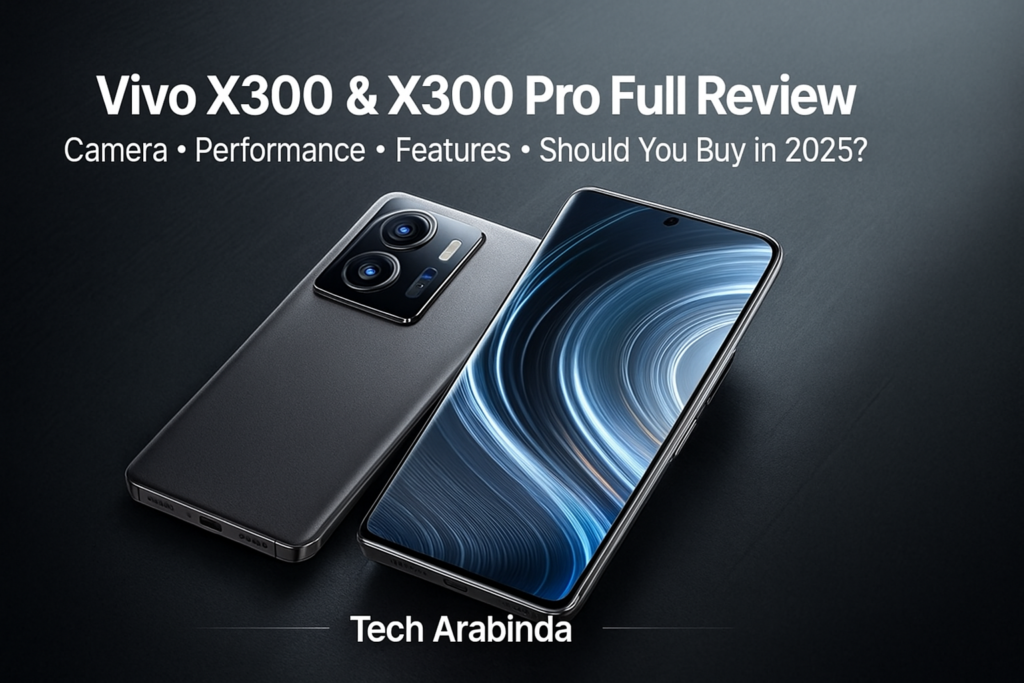

In late 2025, vivo unveiled its much-anticipated X300 series — the vivo X300 and vivo X300 Pro — targeting enthusiast users who demand flagship-class performance, cutting-edge cameras, and long-term software support. These are not just iterative upgrades; they represent vivo’s ambition to challenge premium smartphones from other big brands. In this article, we’ll explore what makes these devices stand out, where they differ, and whether they’re worth your money.
1. First Impressions and Design
From the moment you hold them, both X300 and X300 Pro feel premium. vivo has used a 3D glass unibody design with a flat, modern profile.
Dimensions & Build
- The X300 is lighter and more compact — slimmer profile (about 7.95 mm thickness) and weight around 190 g.
- The X300 Pro is larger and heavier, with a 7.99 mm thickness and weight roughly 226 g.
- Both models come with IP68 and IP69 dust/water-resistance ratings — meaning they are resilient against dust and can survive submersion in water (up to 1.5 m for 30 minutes).
- The screens are covered with “Armor Glass” for added durability.
Overall — the build and design quality are firmly in flagship territory. The X300 leans toward those who prefer a lighter, more pocket-friendly phone; the X300 Pro is for those who want maximum display real estate and don’t mind the extra heft.
2. Display & Performance: Top-Notch Hardware
Display
- X300: 6.31-inch 1.5K LTPO OLED display with ultra-narrow bezels (~1.05 mm), adaptive refresh rate (1–120Hz), HDR10+ support, and peak brightness up to 4500 nits.
- X300 Pro: Larger 6.78-inch 1.5K LTPO OLED panel (BOE Q10+), same 120 Hz refresh rate, same 4500-nit peak brightness.
- Both displays have excellent brightness and support features like full brightness DC dimming and high PWM frequency (2160 Hz), which translates to smoother visuals and more comfortable viewing under various lighting.
Performance
Under the hood, both phones are powered by the flagship MediaTek Dimensity 9500 chipset — a 3 nm processor clocked up to 4.21 GHz, paired with the Arm Mali-G1 Ultra MC12 GPU.
- RAM / Storage: X300 offers 12 GB or 16 GB LPDDR5X RAM with up to 512 GB UFS 4.1 storage. The Pro model ships with 16 GB RAM + 512 GB storage.
- Software: Both run on OriginOS 6, based on Android 16. Importantly, vivo promises 5 years of OS updates and 7 years of security patches for devices in this series — a rarity among Android manufacturers.
Performance-wise, these phones are in the top tier: whether you run heavy games, editing tasks, or multitasking — the hardware is more than capable. The long software support makes them future-proof for many years.
3. Camera Capabilities — Where the X300 Series Truly Shines
The camera system is arguably the biggest reason to consider X300 / X300 Pro — and vivo has taken ’camera phone’ seriously.
vivo X300
- Rear cameras: 200 MP main sensor (Samsung HPB) with OIS, 50 MP ultra-wide lens, and 50 MP periscope telephoto (Sony LYT602) with 3× optical zoom.
- Front camera: 50 MP for selfies, video calls.
- Battery: 6040 mAh with support for 90 W wired charging and 40 W wireless.
This setup makes X300 a powerful all-rounder: high-res main photos, wide-angle shots, and respectable telephoto reach.
vivo X300 Pro: Camera Beast
The X300 Pro goes a step further — rearranging the sensor priorities to emphasize flexibility and optical power.
- Rear cameras: 50 MP Sony LYT-828 main sensor (with gimbal-grade stabilization, bright aperture, suited for low light and motion), 50 MP ultra-wide (JN1), 200 MP periscope telephoto lens (Samsung HPB) for long-range shots with optical zoom and OIS.
- Front camera: 50 MP JN1 selfie lens.
- Imaging Chips: vivo pairs sensors with its custom imaging chips (V3+ and VS1) to handle processing heavy lifting, especially for HDR, dynamic scenes, and cinematic video.
- Video: Capable of 4K HDR cinematic portrait videos — meaning the device isn’t just for still photography but also serious for videography.
- Battery & Charging: 6510 mAh battery, 90 W wired fast charging and 40 W wireless charging.
In short — the X300 Pro aims to rival dedicated cameras for zoomed-in shots, portraits, and creative photography, all within a smartphone. For photography enthusiasts or anyone who cares about camera versatility, this is a serious contender.
4. Battery Life, Charging & Additional Features
Battery capacity and charging performance are often a make-or-break for flagship phones — here, vivo does well:
- Battery: X300’s 6040 mAh and X300 Pro’s 6510 mAh are above average for flagship phones, and promise well over a day of heavy use.
- Charging: Both support 90 W ultra-fast wired charging and 40 W wireless charging — a balanced combination that covers both speed and convenience.
- Extras: Features like in-display 3D ultrasonic fingerprint sensor, stereo speakers, reverse wireless charging, USB 3.2 Gen1 Type-C port, support for Wi-Fi 7, Bluetooth 6.0, NFC, GPS (with NavIC, helpful in India), dual-SIM 5G, show vivo has covered virtually all aspects one expects from a flagship.
Also important: the promise of long-term software updates — 5 years of Android version upgrades + 7 years of security patches. This makes the X300 series a smartphone you can realistically keep for many years without worrying about aging software.
5. Which Model Should You Choose: X300 or X300 Pro?
Here’s a quick comparison to help you decide based on your needs —

|
Your Requirement / Priority |
Recommended Model |
|
Compact size, lighter device, balanced price-to-performance |
X300 |
|
Best photography, telephoto zoom, flexible camera use, larger display |
X300 Pro |
|
Priority on portability, one-handed use, lighter weight |
X300 |
|
Want maximum battery + display size + top hardware for years |
X300 Pro |
|
Want flagship experience at a somewhat lower price |
X300 |
- Choose X300 if you appreciate a more compact phone that’s still powerful and capable of great photos, but with easier handling and lighter feel.
- Choose X300 Pro if camera performance matters a lot — especially long-range shots, portraits, or if you use your phone for photography/videography — and you don’t mind the extra size or cost.
6. Potential Drawbacks & Considerations
No phone is perfect. Here are some potential drawbacks or things to weigh before purchasing:
- The X300 Pro, being heavier and larger, may feel bulky over long usage or be hard to handle with one hand.
- If you mainly use a smartphone for lighter tasks (social media, calling, casual use), you might not fully utilise the powerful telephoto lens or large display of the Pro version — in that case, you may pay extra without proportional benefit.
- For the sake of slimness and design, the phone is glass-bodied: so using a good quality case and guard is advisable to avoid drops or damage.
- As with any flagship, premium pricing: the X300 and especially X300 Pro fall into higher price tiers. Whether the extra features justify the cost depends on individual use cases.
7. Conclusion: Is vivo X300 Series Worth It?
In 2025, when smartphones are rapidly evolving, the vivo X300 and X300 Pro stand out as serious flagship contenders. vivo has balanced design, performance, battery, software support, and — most importantly — camera capabilities in a way that few rivals match.
- For users looking for future-proof performance, long-term support, and balanced flagship experience, the X300 makes a compelling choice.
- For enthusiasts — photographers, mobile content creators, or anyone who wants top-tier cameras, flexibility, and maximum hardware power — the X300 Pro is among the most robust options in the market right now.
Ultimately, whether these phones are “worth it” depends on how you use them. If you want a high-end smartphone that can double as a capable camera — and stay relevant for many years — the vivo X300 series deserves serious consideration.