


In today’s smartphone-driven world, the camera has become one of the most important features when buying a new phone. Whether you love capturing travel moments, clicking food photos, creating social media content, or recording videos, camera quality matters a lot. One of the first things people usually notice while comparing phones is the megapixel (MP) count.
What Does MP Mean in a Phone Camera?
MP stands for megapixel, which means one million pixels. A pixel is the smallest unit of an image, and more pixels usually mean higher image resolution.
For example:
More pixels allow images to retain detail when zoomed or printed large. However, megapixels alone do not guarantee better photo quality.
The Biggest Myth About Megapixels
Many people believe:
“More megapixels = better camera”
This is not always true.
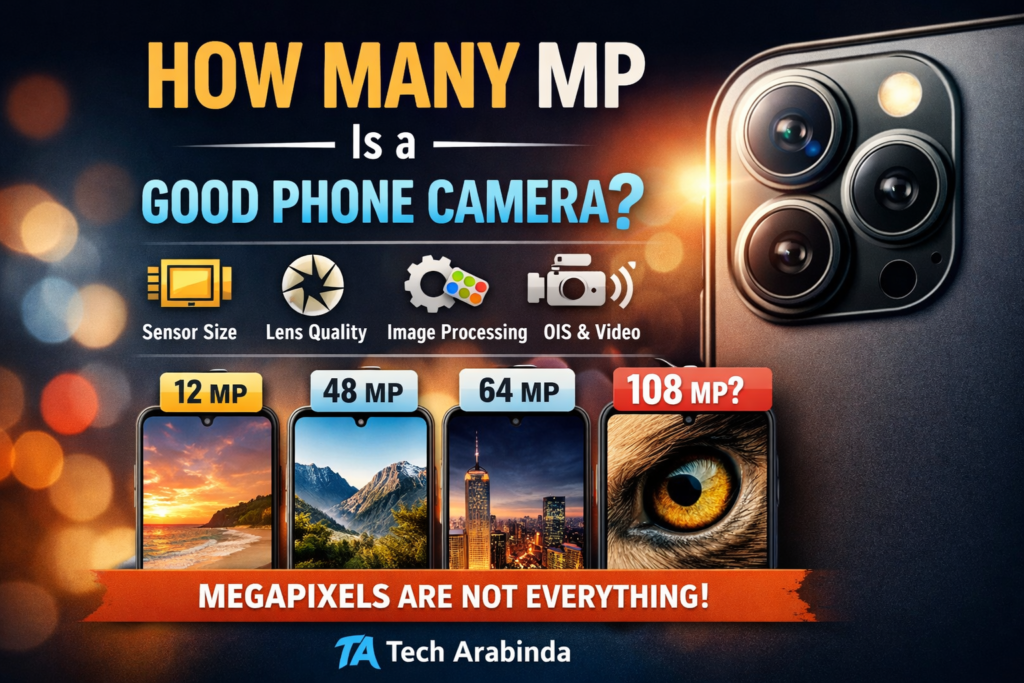
A phone with a 12 MP camera can easily take better photos than a phone with a 64 MP camera if the sensor, software, and lens quality are superior. Megapixels are just one part of a much bigger camera system.
How Many MP Is Enough for Everyday Use?
📱 12 MP – Still Excellent for Most Users
A 12 MP camera is more than enough for:
- Daily photography
- Social media uploads
- Video recording
- Casual travel photos
Even today, many premium smartphones rely on 12 MP sensors because they focus on better light capture and image processing rather than increasing numbers.
If you mostly share photos on Instagram, WhatsApp, or Facebook, you won’t feel any limitation with this resolution.
📸 16 MP to 20 MP – A Balanced Choice
This range is great for users who want:
- Slightly more detail
- Better cropping options
- Sharper images in good lighting
Phones in this category usually offer a nice balance between clarity and file size. For general photography lovers, this is a comfortable sweet spot.
🌄 48 MP – Popular and Practical
A 48 MP camera has become very common in mid-range smartphones. Most of these cameras use pixel-binning technology, combining multiple pixels into one for better brightness and color accuracy.
Benefits include:
- Sharper photos in daylight
- Better zoom and cropping
- Improved night shots when processed correctly
For most users in 2026, 48 MP is more than enough and often ideal.
📷 64 MP – Great for Detail Lovers
A 64 MP camera is useful if you:
- Love landscape photography
- Crop images frequently
- Want more flexibility in editing
However, higher resolution images also take more storage space, and differences are often noticeable only in good lighting conditions.
🔍 108 MP and Above – Mostly Marketing
Phones with 108 MP, 200 MP, or higher cameras sound impressive, but they are not necessary for most people.
These cameras:
- Rarely shoot at full resolution by default
- Depend heavily on software processing
- Are useful mainly for professional-level editing or extreme cropping
For average users, the improvement over 48 MP or 64 MP is often minimal.
Why Megapixels Are Not Everything?
If megapixels don’t tell the full story, what does? Let’s explore the real factors that affect camera quality.
Sensor Size Matters More Than MP
A larger sensor captures more light, which results in:
- Better low-light photos
- Less noise
- More natural colors
A phone with a large sensor and lower MP often beats a small sensor with a very high MP count.
Lens Quality and Aperture
The lens determines how light enters the camera.
- A wider aperture (f/1.8, f/1.6) allows more light
- Better lenses reduce distortion and improve sharpness
This is why two phones with the same MP can produce completely different results.
Image Processing and Software
Modern smartphones rely heavily on software:
Brands with strong camera software often deliver better photos even with lower megapixel sensors.
Optical Image Stabilization (OIS)
OIS helps reduce blur caused by hand movement. It is especially important for:
- Low-light photography
- Night shots
- Video recording
A camera with OIS and moderate MP will outperform a high-MP camera without stabilization.
Front Camera: How Many MP Is Enough?
For selfies and video calls:
- 8 MP is decent
- 12 MP to 16 MP is ideal
More megapixels won’t improve selfies much unless paired with good lighting and software optimization.
Best MP Range Based on User Type
Casual Users
- Recommended: 12 MP – 16 MP
- Focus on ease of use and good auto mode
Social Media Creators
- Recommended: 32 MP – 48 MP
- Look for good color tuning and video quality
Photography Enthusiasts
- Recommended: 48 MP – 64 MP
- Sensor size and software matter more than numbers
Professional or Advanced Users
- Recommended: 64 MP – 108 MP
- Only useful if you edit photos heavily
Does More MP Improve Video Quality?
Not directly.
Video quality depends on:
- Sensor readout
- Stabilization
- Frame rate
- Processing power
Many excellent video phones use 12 MP sensors and still record stunning 4K or even 8K videos.
Storage and Battery Impact
Higher resolution images:
- Consume more storage
- Require more processing power
- Can slightly affect battery life
That’s another reason why extremely high MP cameras are not practical for everyone.
Should You Buy a Phone Based on MP Alone?
Absolutely not.
At Tech Arabinda, we always recommend checking:
- Camera samples
- Low-light performance
- Video stabilization
- User reviews
Real-world performance matters far more than numbers on a box.

Final Verdict:
For most people today:
- 12 MP to 48 MP is more than enough
- 48 MP offers the best balance between quality and practicality
- Anything above that is optional, not essential
Instead of chasing higher megapixels, focus on overall camera quality, sensor performance, and software optimization.
Conclusion
Megapixels are easy to advertise, but real photography is about how well a camera captures light, color, and detail in different conditions. A well-optimized camera with moderate MP can easily outperform a poorly designed high-MP sensor.