

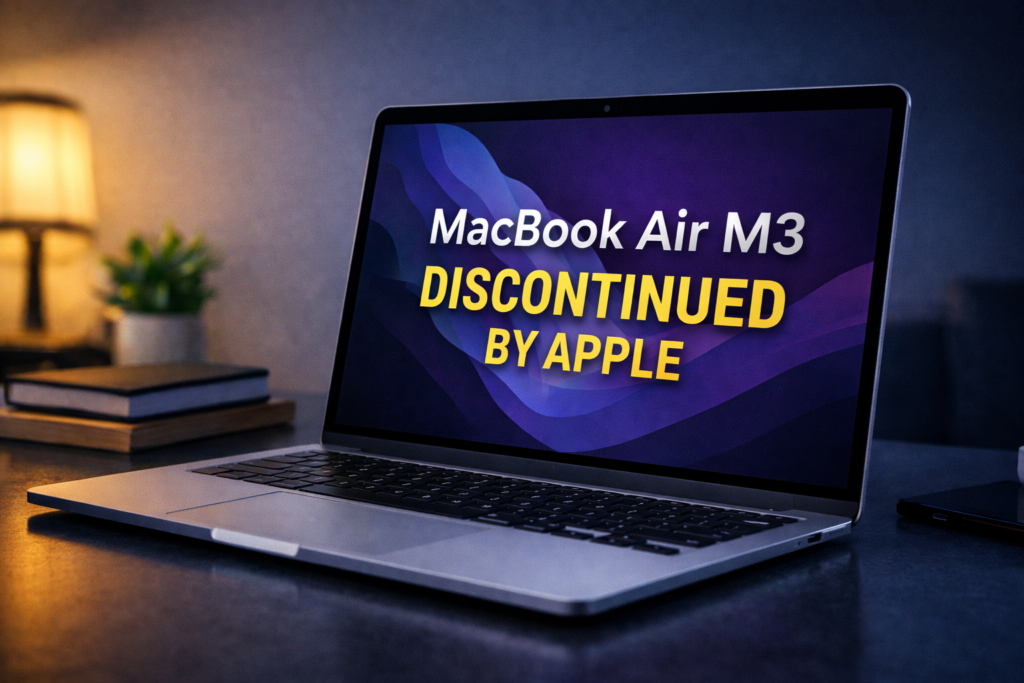

Apple is known for making bold decisions that often reshape the technology industry. One such move that has recently sparked widespread discussion is the discontinuation of the MacBook Air M3. While Apple has not framed this decision as a setback, it has left many users, tech enthusiasts, and potential buyers wondering about the reasons behind it and what comes next.
A Brief Overview of the MacBook Air M3
The MacBook Air M3 was introduced as a refined evolution of Apple’s lightweight laptop series. Powered by the third generation of Apple Silicon, it brought incremental improvements over the M2 model, including better efficiency, faster processing, and enhanced graphics capabilities.
Key highlights of the MacBook Air M3 included:
- Sleek and fanless design
- Excellent battery life
- Improved performance for everyday tasks
- Optimized macOS experience
- Strong appeal for students and professionals
Despite these strengths, the device had a relatively short market life, leading to questions about Apple’s long-term strategy.
Has Apple Officially Discontinued the MacBook Air M3?
Apple rarely announces product discontinuations directly. Instead, it quietly removes devices from its official store once newer models are introduced. The MacBook Air M3 followed this familiar pattern.
Once Apple unveiled its next-generation MacBook lineup, the M3 variant was removed from the primary sales channels. This effectively marked the end of its production cycle, even though refurbished units and third-party sellers may still offer it for a limited time.
Why Did Apple Discontinue the MacBook Air M3?
1. Apple’s Rapid Silicon Development Cycle
Apple’s in-house chip development moves faster than most competitors. With each new generation, Apple focuses on performance gains, energy efficiency, and AI optimization. The M3 chip served as a transitional step rather than a long-term cornerstone.
Discontinuing the MacBook Air M3 allows Apple to streamline its lineup and push users toward more advanced architectures.
2. Lineup Simplification Strategy
Apple prefers a clean and simple product range. Too many overlapping models can confuse buyers and complicate inventory management. By removing the M3 version, Apple ensures clearer differentiation between entry-level and advanced MacBooks.
This strategy also helps Apple focus marketing efforts on fewer, more refined products.
3. Cost and Pricing Adjustments
Manufacturing newer chips often becomes more cost-effective over time. Once Apple optimizes production for newer processors, continuing older models may no longer make financial sense.
Discontinuing the MacBook Air M3 allows Apple to reallocate resources toward devices that offer better margins and future readiness.
4. Preparing for AI-Centric Computing
Modern macOS updates increasingly rely on machine learning and on-device intelligence. Apple is clearly shifting toward AI-first hardware, and newer chips are designed with more powerful neural engines.
The M3, while capable, may not align perfectly with Apple’s long-term AI roadmap.
Impact on Existing MacBook Air M3 Users
If you already own a MacBook Air M3, there is no immediate cause for concern.
Software Updates
Apple typically provides macOS updates for many years after a device is discontinued. Users can expect continued support, security patches, and performance optimizations.
Performance Longevity
The M3 chip remains powerful enough for daily tasks, professional workloads, coding, content creation, and multitasking. Discontinuation does not reduce its capabilities overnight.
Resale Value
Apple products tend to retain resale value well. However, discontinued models may see gradual price drops over time, especially as newer models gain popularity.
Should You Still Buy a MacBook Air M3 in 2025?
This depends on your needs and budget.
When It Makes Sense
- If you find a significant discount
- If your usage is limited to productivity, browsing, and media
- If you prefer a fanless, silent laptop
- If you don’t need the latest hardware features
When You Should Avoid It
- If you want long-term futureproofing
- If AI and advanced workflows matter to you
- If newer MacBooks are available at a small price difference
In many cases, spending slightly more on a newer model may offer better long-term value.
How the Discontinuation Affects the MacBook Air Lineup
The removal of the MacBook Air M3 signals a transition phase. Apple is clearly focusing on:
- More powerful entry-level chips
- Enhanced GPU performance
- Improved thermal efficiency
- Better external display support
This move also hints at a clearer separation between MacBook Air and MacBook Pro models, ensuring each serves a specific audience.

Apple’s History of Discontinuing Products
Apple has a long history of discontinuing products that no longer align with its vision. Examples include:
- Intel-based MacBooks
- iPod lineup
- MacBook 12-inch
- Older iPhone variants
In most cases, discontinuation paved the way for innovation rather than regression. The MacBook Air M3 appears to be another step in this pattern.
What’s Next After the MacBook Air M3?
While Apple remains silent about unreleased products, industry trends suggest:
- More powerful Apple Silicon chips
- Better support for AI and machine learning tasks
- Improved battery efficiency
- Enhanced display technology
- Lighter and thinner designs
Apple’s focus is clearly on pushing MacBooks toward smarter, more capable computing experiences.
How This Decision Impacts Students and Professionals
Students
Students who rely on affordable and reliable laptops may find discontinued models appealing due to price reductions. However, choosing a newer model ensures longer software support.
Professionals
Creative professionals, developers, and power users are better served by newer hardware that can handle demanding workloads and upcoming macOS features.
Market Reaction and Consumer Sentiment
The response to the MacBook Air M3 discontinuation has been mixed:
- Some users see it as an opportunity to buy at lower prices
- Others feel Apple moved on too quickly
- Tech analysts view it as a strategic realignment
(adsbygoogle = window.adsbygoogle || []).push({});
Overall, the decision aligns with Apple’s reputation for aggressive innovation cycles.
Is Apple Moving Too Fast?
One common criticism is that Apple’s rapid updates create shorter product lifespans. While this can be frustrating for recent buyers, it also ensures the ecosystem remains cutting-edge.
Apple prioritizes progress over prolonged support for older hardware, trusting users to upgrade when necessary.
Final Thought
The discontinuation of the MacBook Air M3 is not a sign of failure but a reflection of Apple’s fast-paced innovation strategy. While the M3 model was a capable and well-designed laptop, Apple’s vision clearly extends beyond incremental upgrades.
For existing users, the MacBook Air M3 remains a reliable and powerful device. For new buyers, it’s a matter of balancing price, performance, and future readiness.
As Apple continues to redefine personal computing, such decisions remind us that in the world of technology, change is constant—and often necessary.