


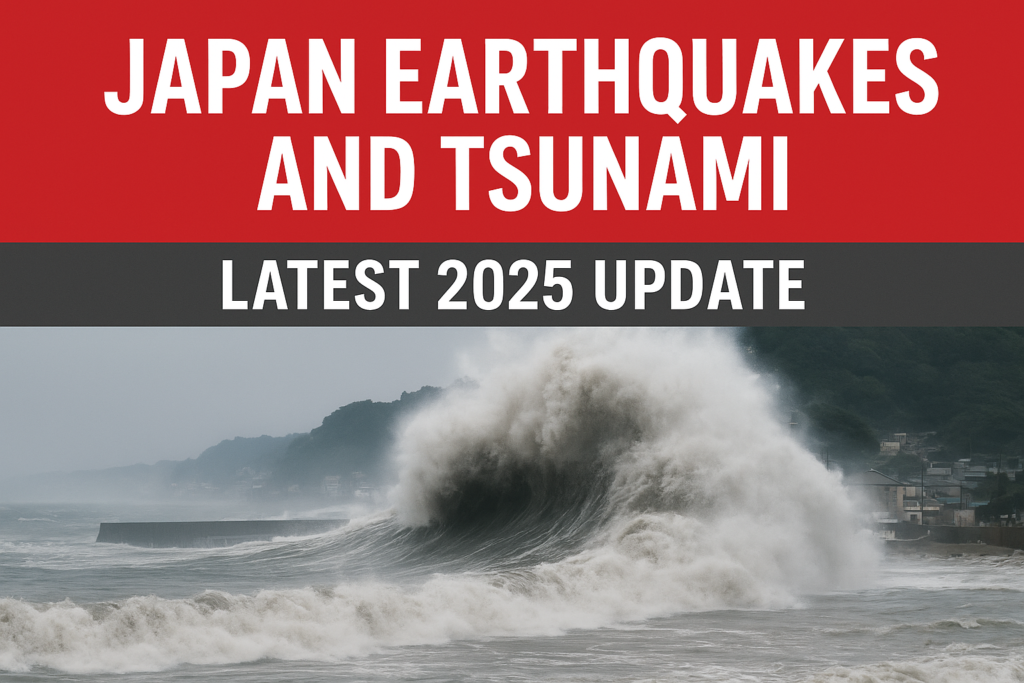

Japan has long been one of the most disaster-resilient nations in the world, yet it also remains one of the most disaster-vulnerable. Positioned on a volatile tectonic boundary, the country frequently experiences powerful earthquakes that sometimes trigger devastating tsunami waves. These natural events have shaped the nation’s infrastructure, scientific advancements, culture, and national preparedness strategies. The science behind Japan’s seismic activity, major historical disasters, a recent earthquake-tsunami event in 2025, early-warning systems, recovery efforts, and what future generations must prepare for.
Why Japan Faces Frequent Earthquakes and Tsunami Events
Japan sits on the convergence point of four major tectonic plates:
- Pacific Plate
- Philippine Sea Plate
- Eurasian Plate
- North American Plate
This location, known as the Pacific Ring of Fire, is the most active seismic zone on Earth. As these plates continuously shift, pressure builds up and eventually releases in the form of earthquakes. When these quakes occur under the ocean floor, they can displace massive volumes of water, producing tsunami waves that travel across oceans at incredible speeds.
This natural setup makes Japan one of the most closely monitored regions for seismic activity, with scientists across the globe studying it to improve prediction models and early response strategies.
A Historical Overview of Japan’s Deadliest Seismic Disasters
Japan has experienced countless tremors throughout its history, but some events left unforgettable marks on the country’s landscape and society.
1. The Great Kanto Earthquake – 1923
Striking the Kanto region, this disaster destroyed large parts of Tokyo and Yokohama. Intense fires that followed caused even more damage, leaving over 100,000 people dead. It was a turning point in Japan’s urban planning and led to stricter building regulations.
2. Showa Sanriku Tsunami – 1933
Triggered by a major offshore quake, this tsunami caused widespread destruction along the northeastern coastline. Entire villages were swept away, and thousands of lives were lost. It remains one of the most powerful tsunami events recorded in the region before modern monitoring systems existed.
3. The Great Hanshin Earthquake – 1995
Kobe and surrounding areas suffered catastrophic damage when a strong inland earthquake struck early in the morning. Over 6,000 people were killed, and the disaster revealed gaps in emergency response. It also prompted modernization of Japan’s building codes and communication systems.
4. Tōhoku Earthquake and Tsunami – 2011
One of the strongest earthquakes ever measured globally struck off the northeastern coast of Japan. The resulting tsunami destroyed coastal towns, caused nearly 18,500 deaths, and led to the Fukushima Daiichi nuclear crisis. This disaster changed global perspectives on nuclear safety, disaster management, and early-warning technologies.
Recent Incident: December 2025 Earthquake and Tsunami Alert
In the early hours of December 8, 2025, a powerful offshore quake — initially measured at 7.6 (later adjusted to 7.5) — struck near the coast of the Aomori Prefecture in northeastern Japan.
- The epicenter was roughly 80 kilometres off the Aomori coast, at a depth of about 54 km.
- The quake triggered widespread shaking; in some cities the tremor registered as “upper 6” on the national intensity scale — strong enough to make standing difficult.
- Authorities issued tsunami warnings for multiple prefectures including Hokkaido, Aomori and Iwate Prefecture, and ordered evacuations for around 90,000 residents.
- Initial forecasts warned of possible waves up to 3 metres high — though observed waves were much smaller, between 20 and 70 cm, and the warnings were downgraded after a few hours.
- At least 30–50 people were reported injured, mostly due to falling objects. Some road damage occurred and power outages affected households in affected regions; train services including high-speed lines were temporarily halted.
- The quake prompted the government to issue a rare “megaquake advisory,” warning that stronger aftershocks, or even a bigger earthquake, could follow in the coming days.
While the immediate physical destruction was limited, the event underscores the persistent seismic threat Japan faces — even decades after tragedies like the 2011 wave.
This recent incident serves as a sober reminder that even well-prepared societies remain vulnerable, and reinforces the importance of continuous vigilance and readiness.
The Science Behind a Tsunami: How Waves Become Walls of Water
A tsunami forms when the seafloor suddenly shifts due to an underwater earthquake, volcanic eruption, or landslide. The energy released moves outward as waves that initially have small heights but extremely long wavelengths. As these waves reach shallow coastal waters, they rise dramatically, creating the destructive walls of water that strike land.
Japan’s modern monitoring systems track these changes in real time. Sensors installed on the seabed, satellites, and coastal towers work together to measure water pressure, wave speed, and tectonic movement, giving residents precious minutes to evacuate. The December-2025 quake once again demonstrated how these systems — including quick tsunami advisories — can help mitigate damage.
Japan’s Early Warning Systems: A Global Benchmark
Japan has built the world’s most advanced disaster-alert network. After major past tragedies, the government invested heavily in technology to minimize casualties. Key systems include:
1. Earthquake Early Warning (EEW)
This system detects the first seismic waves and instantly issues alarms to mobile phones, televisions, trains, and public speakers. While it only provides seconds of advance notice, those seconds can save lives. The 2025 incident reportedly triggered such alerts, allowing many residents to move to safer zones.
2. Tsunami Warning Network
The Japan Meteorological Agency (JMA) uses seabed sensors, GPS data, and real-time ocean monitoring to determine when a tsunami has formed. Alerts specify projected wave heights and estimated arrival times, allowing coastal communities to evacuate rapidly. The December alert demonstrated the system’s efficacy despite initial scare.
3. Automated Infrastructure Safety
Modern trains, factory equipment, elevators, and nuclear reactors automatically shut down when strong tremors are detected, preventing secondary accidents. In the latest quake, railway services were halted promptly to avoid derailments or accidents.
These innovations make Japan not only resilient but a global leader in disaster management.
How Japan Rebuilds After Major Disasters — And Prepares for the Next
Reconstruction in Japan is more than just rebuilding structures — it focuses on creating safer, stronger, and more adaptable communities.
1. Disaster-Resistant Architecture
Japanese buildings are engineered to sway rather than collapse. Modern skyscrapers use shock-absorbing foundations and advanced damping systems that counteract seismic motion. The consistent enforcement of building codes remains a legacy of past catastrophes.
2. Elevated Coastal Barriers
After the 2011 disaster, Japan constructed high seawalls along vulnerable coastal areas. While not a perfect solution, they significantly reduce the impact of incoming waves. The 2025 quake reaffirmed that such infrastructure still plays a key role in mitigation.
3. Community Preparedness
Schools regularly conduct evacuation drills. Residents are taught how to react during different types of disasters, and community shelters are stocked with supplies. Citizens are trained to respond quickly to alerts such as those issued by JMA.
4. Government and Military Response
The Self-Defence Forces play a major role in humanitarian operations, providing rapid rescue, supply distribution, and medical support. After the latest event, national and regional agencies quickly coordinated evacuations and damage assessments.
Japan’s ability to recover quickly from disasters is admired internationally and serves as a blueprint for other nations facing similar threats.
Environmental, Social and Economic Effects of Large-Scale Tsunamis
A tsunami leaves not only physical destruction but also long-term ecological and societal impacts.
1. Landscape Transformation
Coastal regions often experience soil salinization, erosion, and destruction of agricultural fields. It can take years for the land to recover.
2. Marine Ecosystem Disruption
Fish populations, coral reefs, and ocean habitats are often disturbed by the sudden movement of water and debris.
3. Psychological Impact
Communities dealing with repeated seismic events face stress, trauma, and long-term emotional challenges. Support systems and counseling services are essential for affected families.
4. Economic Losses
Infrastructure, homes, industries, and tourism sectors are often heavily damaged. Japan has spent trillions of yen on reconstruction projects after major disasters. The 2025 quake — though not catastrophic — disrupted transportation and power supply, reminding that even “moderate” events carry serious economic costs.

Can Earthquakes and Tsunamis Be Predicted?
While scientists can identify high-risk zones, no technology can precisely predict the exact time of an earthquake. However, advancements in AI, ocean-floor sensors, and satellite data analysis are gradually improving the accuracy of risk assessments. Research into seismic precursors and tsunami-generation models offers hope, but unpredictability remains.
The December 2025 event shows that although the alarm systems work, we still can’t forecast exactly when or how strong the “next big one” will be.
Future Risks and the Possibility of the Next Megaquake
Experts warn that Japan’s tectonic environment remains active, with a potentially major event expected along the Nankai Trough, a deep ocean trench south of Honshu. If this region ruptures, it could trigger a massive tsunami and cause widespread damage across major cities like Osaka and Nagoya. Historical events such as the 1707 and 1854 tremors show that southern Japan is not immune to megathrust disasters.
Japan is therefore strengthening buildings, improving evacuation routes, and increasing public awareness to prepare for the next major quake — but as the December 2025 tremor confirmed, the threat remains ever-present.
How Japan’s Recent Quake Reaffirms the Importance of Preparedness
The December 2025 earthquake and tsunami alert provided fresh evidence that:
- Even a well-prepared country can face sudden seismic events, regardless of past disasters;
- Early-warning infrastructure and public alert systems are essential;
- Resilience depends not only on engineering but also on civic discipline, awareness, and readiness;
- The window between initial tremor and tsunami wave can be narrow — making seconds matter.
The event serves as a modern stress test of Japan’s disaster-management systems, reaffirming lessons learned over decades of seismic history.
How Japan Inspires the World in Disaster Preparedness
Japan’s consistent efforts in innovation, education, and community preparedness make it a global leader in disaster resilience. Nations vulnerable to similar natural threats look to Japan as a model for building smarter cities, improving alert systems, and strengthening infrastructure.
After the 2025 tremor, experts worldwide are re-evaluating whether their own warning systems are up to the task. The ability of communities to respond quickly — and of governments to coordinate emergency measures — can make all the difference.
Final Thoughts
Earthquakes and tsunami events have shaped Japan into one of the most resilient and scientifically advanced nations in the world. While the risks remain high due to its geographical location, continuous innovation, strong community spirit, and government preparedness help minimize potential damage. The December 2025 quake-alert shows that even now, nature can surprise us — but through preparedness, technology, and collective will, loss of life can be prevented.
Through its sophisticated warning systems, architectural brilliance, and comprehensive disaster management strategies, Japan proves that even in the face of nature’s greatest forces, human determination and technology can save lives.